
Tooth loss is a common problem that can lead to a wide range of oral and overall health issues, and it’s best to replace missing teeth as soon as possible. A dental bridge from Dr. Howard’s office can be a great way to address the loss of one or a few missing teeth in a row, which can keep a patient’s mouth healthy while helping them feel good about their appearance. Here’s a quick look at how dental bridges work, but please feel free to schedule a consultation at our San Marcos office.

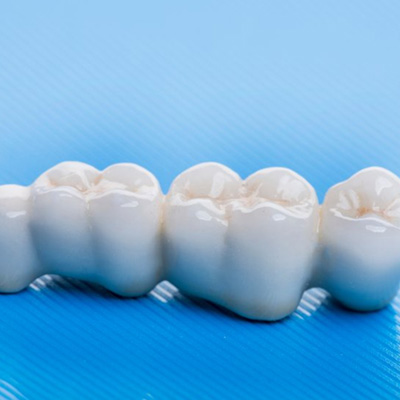
Dental bridges consist of one or more artificial teeth supported by two dental crowns or dental implants. These devices are often used to replace up to three teeth in a row, and they can help a patient chew thoroughly, speak clearly, and smile proudly. Bridges are usually crafted from strong metal or ceramic materials, and they can be great options for people who are missing several sequential teeth as long as they have healthy teeth or strong jawbones on either side of their gaps. Some patients will need preliminary treatments to clear up oral infections or reinforce their jawbones before receiving dental bridges.

After examining your mouth and discussing your needs and preferences during your consultation, Dr. Howard may recommend an appliance such as:
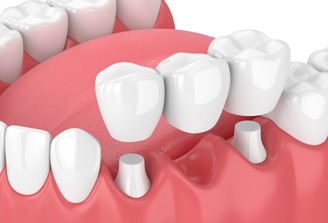
A traditional dental bridge is one or more artificial teeth strung between two dental crowns. These devices must be mounted on healthy teeth on either side of the gap caused by tooth loss, which will require the removal of a small amount of enamel. With excellent care, traditional bridges can last for seven years or more.
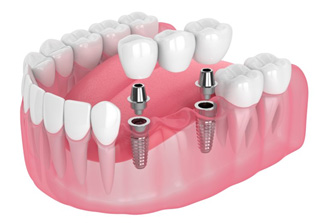
An implant bridge is a line of two to four artificial teeth designed to be supported by dental implants surgically anchored in the jawbone. These devices offer superior chewing power and longevity.

Dental bridges offer a range of remarkable benefits like:
Dr. Howard will be happy to determine the best way to replace your lost teeth during your consultation.
No, you can’t take dental bridges out once they’re placed. Only a dental professional is qualified to do that.
To be specific, dental bridges are “fixed restorations.” A dentist cements them to special “abutments” (i.e., nearby natural teeth) to fill your smile gaps. As such, you can’t remove them once they’ve bonded to your smile; trying to do so would just harm your oral health.
If your dental bridge needs repairs or replacement, only a dentist can (and should) remove it. Their resources would ensure they do so safely, without damaging your remaining teeth or gums.
Whatever you might’ve heard, it doesn’t hurt to get a dental bridge. A dentist takes steps to make the process smooth, easy, and pain-free.
Most crucially, the dental team will numb your mouth before they place your dental bridge. All they have to do is apply a topical anesthetic to the treatment site. Once they’ve done that, a dental bridge can be placed without causing any pain; you’ll only sense a slight pressure as that work proceeds.
After the preparation and placement, your underlying teeth will just feel a tad sore. You can easily manage this sensation with some over-the-counter pain medication. Plus, any felt sensitivity should fade within a few days of your treatment.
A dental bridge can replace up to four missing teeth in a row. That said, most dentists only use them to replace a tooth or two.
The issue is that dental bridges become unstable as they extend. When they go too far out, these devices will usually fall apart and fail. It's thus risky to have a bridge replace three or more teeth.
Of course, implant bridges are an exception to the rule. These kinds are secured with implant posts instead of natural teeth, so they can extend without a high risk of failure.
Truthfully, today’s metal-free bridges look quite natural. You can trust them to blend seamlessly with your adjacent teeth, making your smile look whole and beautiful.
It comes down to the materials that metal-free bridges use. These kinds are made of ceramic, zirconia, and similar substances, which can be color-matched to your other teeth. That means a bridge using them will look remarkably like your enamel, all without “standing out” oddly.
Even better, a dental bridge won’t fall out like a denture might. It’s cemented to your abutments (i.e., nearby natural teeth) to ensure it stays in place.
